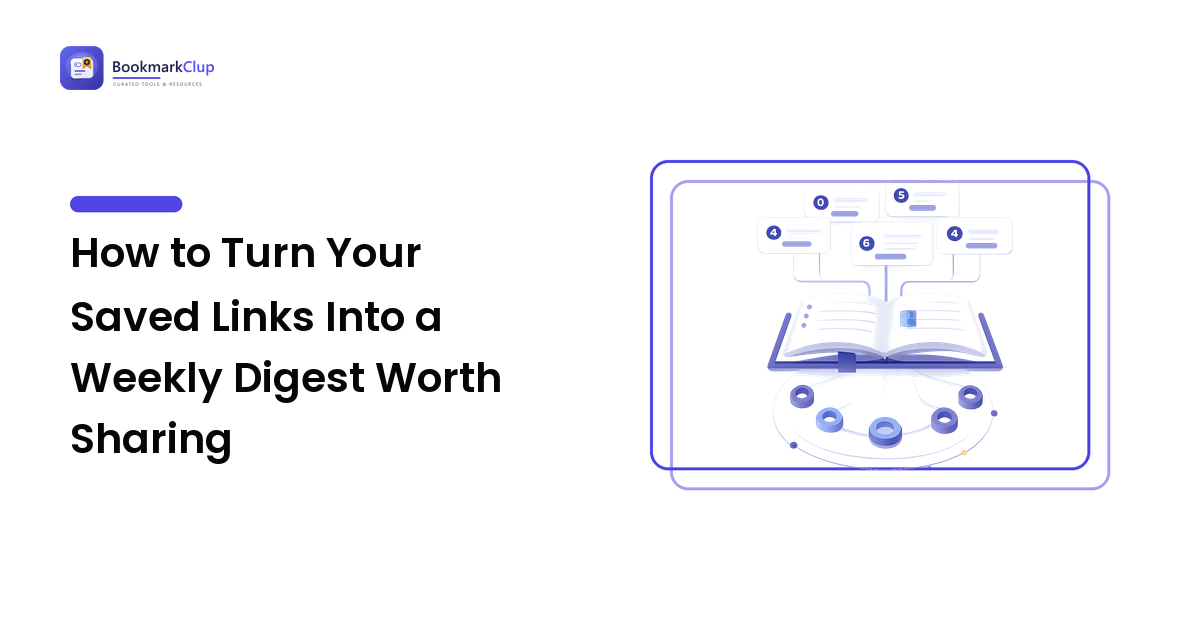
To turn saved links into a weekly digest, tag keepers as you save them, set a fixed 30-minute review slot, shortlist five to ten links, write one honest sentence on each explaining why it's worth a click, check every URL still loads, then send it the same day each week. The rhythm matters more than the polish.
Most people who save a lot of links eventually think: someone else would find these useful. Then they try to write a roundup from scratch on a Friday afternoon, can't remember why they saved half of them, and quietly give up. The problem isn't effort or taste — it's that curation was treated as a one-off writing task instead of a small workflow running on the saving you already do.
This walkthrough gives you that workflow — seven steps, each with a way to check it worked. It applies whether your digest goes to a newsletter, a team channel, or a private note to yourself.
What do you need before you start?
Almost nothing, which is the point. Three things:
- One place where saved links land. Not four. If half your keepers are in a browser folder and half in a read-later app, your digest will always be missing something. Still deciding where that place should be? Work through the discovery system first — a digest is only as good as the sources feeding it.
- A way to tag a save. Anything that lets you mark "this one's for the digest" at save time. Folders work; tags work better, because a link can be both a digest candidate and part of a research collection.
- A destination. A newsletter tool, a team channel, a shared collection, a document. Pick one now — deferring this is the most common reason a digest never ships.
That's it. No template, no design, no scheduling software. Add those once the habit is real.
What are the steps to build a weekly link digest?
Work through these in order. Each has a verification check — a concrete signal it worked. Don't move on until it passes, because a failure at step 2 quietly ruins step 5.
Step 1 — Choose your day, length, and audience
Write down three things: which day the digest goes out, roughly how many links it carries, and who it's for. Five to ten is the sweet spot — enough to be worth opening, few enough to genuinely vouch for each one.
Why these three: the day creates the deadline; the count stops the digest ballooning into an unsendable backlog; the audience lets you reject a good link that's simply wrong for these readers.
Verify it worked: you can finish the sentence "Every Thursday I send about seven links to _____." out loud. If the blank is vague ("people interested in design"), narrow it until it names someone real.
Step 2 — Tag keepers at the moment you save
When a link is obviously digest-worthy, mark it right then with a dedicated tag — something like digest or digest-candidate. It takes half a second while the page is still in front of you, and it's the highest-leverage habit in the whole workflow.
Why at save time: deciding "was this good?" a week later means reopening and re-reading the page. Deciding now costs nothing. If your tags are messy in general, the verb-and-noun tagging method will keep this new tag from getting lost among fifty others.
Verify it worked: on day three or four, filter your library by that tag. If it returns a handful of links you recognise without opening them, the tag is doing its job. If it's empty, you're not tagging at save time — set a reminder for a week.
Step 3 — Book the review slot
Put a recurring 30-minute block on your calendar the day before send day — the only scheduled work the digest requires. Curation done "when I get a moment" competes with everything else and loses; a booked slot is an appointment you keep or consciously skip.
Verify it worked: the block exists as a repeating calendar event, named for the digest, and it isn't during a period you routinely double-book.
Step 4 — Shortlist against one honest question
In your review slot, open the tagged links and ask one question of each: would I personally send this to one specific person I respect? Yes goes in the shortlist. Hesitation is a no. Cut down to your target count.
Why this question: it replaces an impossible standard ("is this objectively important?") with a decision you can make in seconds, and it filters out links you saved from obligation rather than interest.
Verify it worked: your shortlist is at or below target and you can name, for each link, the person you'd send it to. If you're padding to hit a count, send fewer — a short digest is fine; a padded one teaches readers to skim past you.
Step 5 — Write one sentence per link
For each shortlisted link, write one sentence saying what it is and why it's worth the click. Not a summary — a reason. "A working photographer's argument that most gear advice is aimed at people who don't shoot" beats "An interesting article about camera gear" every time. That sentence is the entire value you add over a raw list of URLs, and the one-sentence cap keeps the digest writable in twenty minutes.
Verify it worked: read your sentences with the links hidden. If you can still tell which one you'd click, they're doing their job. If they're interchangeable, they're descriptions, not reasons — rewrite.
Step 6 — Check every link still resolves
Open each URL fresh before sending, ideally in a private window — which also reveals paywalls your logged-in session hides. Replace or drop anything that 404s, redirects somewhere odd, or is now gated. A dead link costs more trust than a missing one, and pages rot faster than most people expect, as covered in saving bookmarks before they die.
Verify it worked: every link in the draft has been clicked once, from a logged-out session, in this sitting.
Step 7 — Send, then archive the issue
Send to your chosen destination, move the included links to an archive tag or dated collection, and clear the digest tag so next week starts empty. The archive is a searchable record of what you've already shared, which stops you re-sending the same link in three weeks.
Verify it worked: your digest tag returns zero results right after sending. That empty state is the system's reset button.
How do you keep the habit from dying?
Digests usually die in weeks three to five, for one of three reasons.
It got too long. A twenty-link issue takes an evening to produce. Cut back to your original count; the shorter one gets read anyway.
The saving stopped. No tagged links, nothing to curate. That's a capture problem — fix the input side with a steady source list, where a small set of RSS feeds beats any amount of scrolling.
It went quiet with no plan. Missing a week is fine; missing it silently makes the next send feel awkward, so you skip that one too. Say "no issue this week" in one line, or send late.
And if your digest goes to colleagues rather than subscribers, a living shared collection often beats an email, because it stays current after you hit send — see sharing bookmarks with a team.
FAQ
How many links should a weekly digest contain?
Five to ten works for a weekly rhythm: enough to justify opening, few enough that you can honestly vouch for each after one review session. If you consistently struggle to reach five, switch to fortnightly rather than padding.
What if I don't have an audience yet?
Send it to yourself, or to one person. A digest with one reader is still a working system, and it's far easier to grow an existing habit than to start one the day you finally have subscribers.
Does sharing links in a digest help the sites I link to rank better?
Don't count on it, and don't build your digest around the idea. Links shared through bookmarking services and most social platforms are typically marked nofollow or wrapped in redirects, so they generally aren't treated as ranking signals. The real value is attention from actual readers.
Should I write the digest in my bookmark tool or a separate document?
Draft wherever your links already live, then paste into your sending tool at the end. Writing the reason next to the saved link keeps the annotation attached to the bookmark and saves you toggling windows to work out which URL a sentence belongs to.
How do I handle a great link that doesn't fit this week's theme?
Keep a "someday" tag separate from your digest tag and park it there. A strong link held for six weeks is usually more useful in a themed issue than shoehorned into an unrelated one — just review the someday pile quarterly so it doesn't become a graveyard.
Next step
Pick your day, your count, and your one reader before you close this tab, then tag the next good link you save. In seven days you'll have a shortlist waiting instead of a blank page — that difference is the whole workflow. For a model of what a tight weekly issue looks like, the 10 links worth keeping newsletter at BookmarkClup runs on exactly this rhythm.